


 Psychopharmacology
 MK-801 and cognitive functions: investigating the behavioral effects of a non-competitive NMDA receptor antagonist

The takeaway
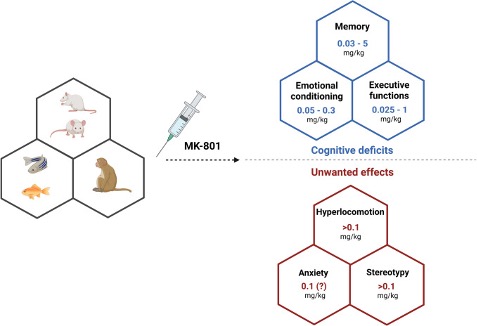
MK-801 (dizocilpine), a non-competitive NMDA receptor antagonist, is a widely used pharmacological tool to model cognitive deficits. It reliably causes impairments in various types of memory and executive functions across different species, making it essential for testing procognitive and antipsychotic drug candidates.
The science
By blocking NMDA receptor signaling, MK-801 impairs synaptic plasticity and memory. Both acute and chronic use disrupt object recognition, Morris water maze performance, and fear conditioning, while also decreasing working memory and cognitive flexibility in touchscreen and maze tasks. The effects depend on dose, sex, strain, and developmental stage, with low doses (≤0.1 mg/kg) causing cognitive deficits without severe hyperactivity. Although state-dependent effects and confounding factors like stereotypy make interpretation challenging, consistent deficits in hippocampal- and prefrontal-dependent tasks support its application.
Why it matters
MK-801 is a vital tool in preclinical studies, offering a reliable model of NMDA receptor hypofunction that aids in exploring underlying mechanisms and testing new treatments for schizophrenia, depression, and other cognitive disorder-related conditions.
Orginal article
https://doi.org/10.1007/s00213-023-06454-z
Our other publications
The initiative focuses on promotion techniques that can revolutionize traditional research approaches pharmaceuticals.
 Neurochemical Research
 Neuroscience and Biobehaviroal Reviews